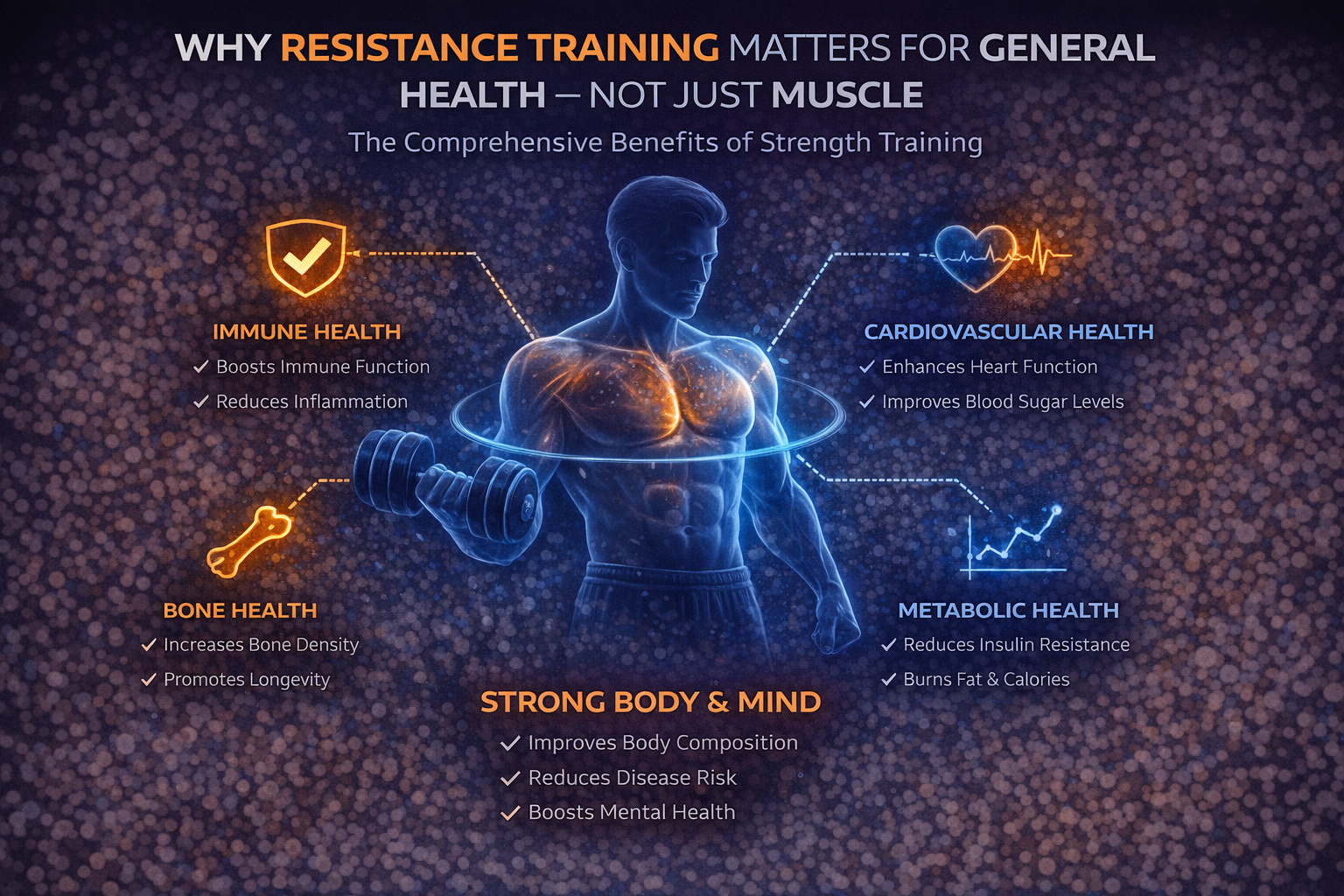
Resistance training is often discussed in the context of aesthetics: building muscle, improving body composition, getting stronger. These are legitimate outcomes. But the case for resistance training as a general health intervention is arguably even more compelling, and it is supported by a rapidly expanding body of research across longevity, metabolic health, bone density, mental health, and functional capacity.
If you are not resistance training, you are leaving significant health benefits on the table, regardless of whether aesthetics are your goal.
Muscle Mass as a Metabolic Organ
Skeletal muscle is the largest metabolically active tissue in the body. It is responsible for the majority of insulin-mediated glucose uptake. Muscle cells act as a significant glucose sink; when you eat carbohydrates, skeletal muscle is one of the primary destinations for the resulting blood glucose. This makes muscle mass a key determinant of insulin sensitivity.
People with greater muscle mass have meaningfully better glucose disposal, lower insulin requirements, and reduced type 2 diabetes risk. Resistance training improves insulin sensitivity both acutely (through the contraction itself) and chronically (through increased muscle mass and GLUT4 transporter expression).
Bone Health and Osteoporosis Prevention
Bone is living tissue that remodels in response to mechanical loading. Resistance training applies compressive and tensile forces to bone that stimulate osteoblast activity, the process by which new bone tissue is deposited. This is the most effective non-pharmacological intervention for increasing bone mineral density in adults.
Bone loss accelerates with age and with inactivity. By the time osteoporosis becomes clinically apparent, significant bone mass has already been lost. Building and maintaining bone density through consistent resistance training across the lifespan is substantially more effective than attempting to reverse established loss.
Grip strength, a proxy for overall muscular strength, is one of the most reliable predictors of all-cause mortality in large epidemiological studies. Stronger people tend to live longer. This relationship appears causal, not merely correlational.
Longevity and Functional Independence
Muscle mass declines at a rate of approximately 3–5% per decade after age 30, accelerating to 10–15% per decade after 60 in sedentary individuals, a process called sarcopenia. Loss of muscle mass is directly associated with reduced functional capacity, increased fall risk, loss of independence, and all-cause mortality in older populations.
Resistance training is the primary intervention that attenuates this decline. Studies consistently show that even older adults who have never trained before respond meaningfully to resistance exercise, gaining strength, improving balance, and reducing fall risk within weeks to months of beginning a program.
Metabolic Rate and Body Composition
Muscle tissue has a higher metabolic rate than fat tissue. Increasing muscle mass raises resting metabolic rate: meaning the body burns more calories at baseline. This is modest on a per-pound basis but meaningful in aggregate, and it creates a more favorable body composition environment over the long term.
For individuals managing body weight, preserving and building muscle while managing calorie intake produces better long-term outcomes than calorie restriction alone, which tends to cause significant lean mass loss alongside fat loss.
Mental Health and Cognitive Function
The evidence for resistance training's mental health benefits has grown substantially. Meta-analyses consistently find resistance training reduces symptoms of depression and anxiety, improves self-efficacy and confidence, and enhances sleep quality. The mechanisms involve endorphin release, BDNF (brain-derived neurotrophic factor) upregulation, and systemic reductions in inflammatory markers that contribute to depressive symptomatology.
Cognitive benefits are also emerging, particularly for executive function and memory in middle-aged and older adults. Regular resistance training appears to reduce the risk and rate of cognitive decline.
Bottom Line
Resistance training is not merely an aesthetic tool. It is one of the most powerful, evidence-supported health interventions available: with meaningful benefits for metabolic health, bone density, longevity, mental health, and functional independence. Two to three sessions per week of progressive resistance training is sufficient to realize most of these benefits. The question is not whether to do it; it is how to get started and stay consistent.