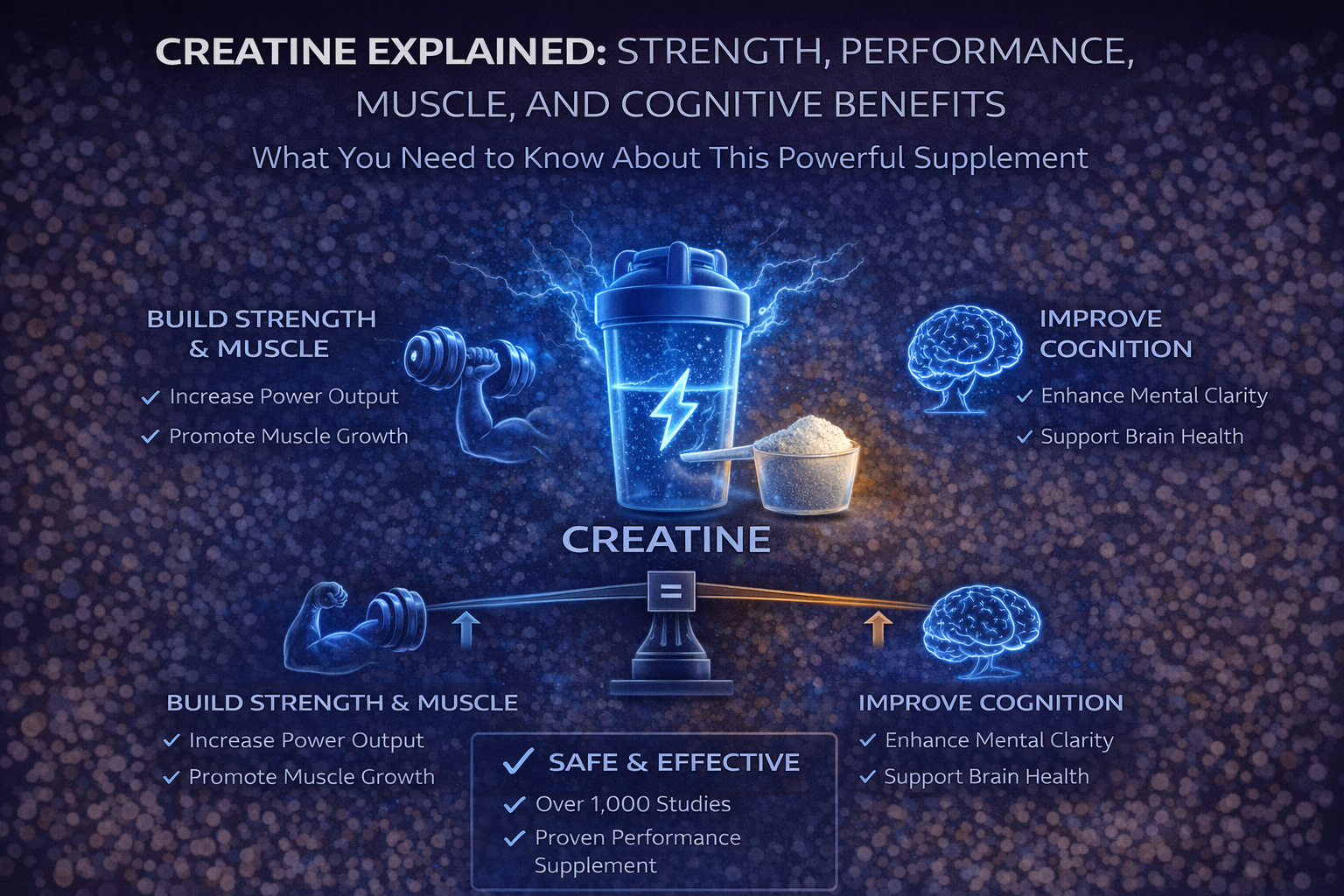
Creatine monohydrate is the most thoroughly researched performance supplement in existence, with over 500 peer-reviewed studies spanning more than three decades. It is safe, it is effective, and it is one of the few supplements where the gap between what the marketing says and what the research shows is actually narrow. Despite this, misconceptions about it persist. This article explains what creatine is, how it works, and who benefits.
What Creatine Is
Creatine is a naturally occurring compound synthesized in the liver, kidneys, and pancreas from three amino acids: arginine, glycine, and methionine. It is also found in red meat and fish. About 95% of the body's creatine is stored in skeletal muscle, primarily as phosphocreatine, the form used for rapid ATP regeneration during high-intensity activity.
ATP (adenosine triphosphate) is the immediate energy currency of cells. During explosive, short-duration efforts, such as a heavy squat, a sprint, or a jump, ATP is consumed faster than it can be regenerated through aerobic metabolism. The phosphocreatine system provides a rapid buffer by donating a phosphate group to ADP, quickly regenerating ATP. This system operates for approximately 6–10 seconds of maximal effort before phosphocreatine is depleted.
How Creatine Supplementation Works
Most people's muscle creatine stores are approximately 60–80% saturated through dietary intake. Supplementation increases muscle phosphocreatine stores toward full saturation, typically a 15–40% increase. This expanded phosphocreatine pool allows for greater ATP availability during repeated high-intensity efforts, more work done per session, and faster recovery between sets.
Over time, the ability to do more work in training, meaning more reps, more sets, and greater total volume, compounds into meaningfully greater strength and muscle gains. Creatine does not directly cause hypertrophy; it enables the training quality that drives hypertrophy.
Creatine monohydrate is the most studied form and has the strongest evidence base. Other forms, including creatine HCl, buffered creatine, and creatine ethyl ester, are marketed as superior but have not outperformed monohydrate in research. Stick with monohydrate.
Strength and Performance
The evidence for creatine's effect on strength and high-intensity performance is consistent and large. Meta-analyses show average improvements in 1RM strength of 5–15% over training periods of several weeks, and improvements in repeated sprint and power output of 5–15% as well. These are not marginal effects; they are meaningful and reproducible across a wide range of populations and training types.
Muscle Mass
Creatine supplementation consistently produces greater lean mass gains when combined with resistance training compared to training alone. Part of this is functional: increased intramuscular water retention (creatine draws water into muscle cells) increases cell volume, which is a pro-anabolic signal. Part is structural: the ability to train harder over time accelerates muscle protein synthesis and hypertrophy.
The initial weight gain (often 1–2 kg) seen when starting creatine is primarily water. This is not fat gain; it is intramuscular water, which actually has a positive effect on muscle cell function and protein synthesis signaling.
Cognitive Benefits
Emerging and increasingly robust research suggests creatine has meaningful cognitive effects. The brain relies on phosphocreatine for ATP regeneration under conditions of high cognitive demand. Supplementation has been shown to improve working memory, cognitive performance under sleep deprivation, and processing speed, particularly in vegetarians and vegans (who have lower baseline creatine levels from diet) and in older adults.
Safety
Creatine has an excellent safety profile across decades of research. It does not cause kidney damage in healthy individuals; this myth originated from a case report involving a person with pre-existing kidney disease. Long-term studies in healthy populations show no adverse effects. It is one of the most extensively safety-tested sports supplements available.
Practical Use
A maintenance dose of 3–5 grams per day of creatine monohydrate is effective for maintaining elevated phosphocreatine stores. Loading phases (20 grams per day for 5–7 days) saturate stores faster but are not necessary; saturation at the maintenance dose occurs within 3–4 weeks. Timing is largely irrelevant; consistency matters more than the specific window.
Bottom Line
Creatine monohydrate is the single most evidence-supported performance supplement available. Its effects on strength, power, lean mass, and cognitive function are well-documented and meaningful. It is inexpensive, safe for healthy individuals, and has virtually no downside at standard doses. If you resistance train and are not using it, it is worth reconsidering.