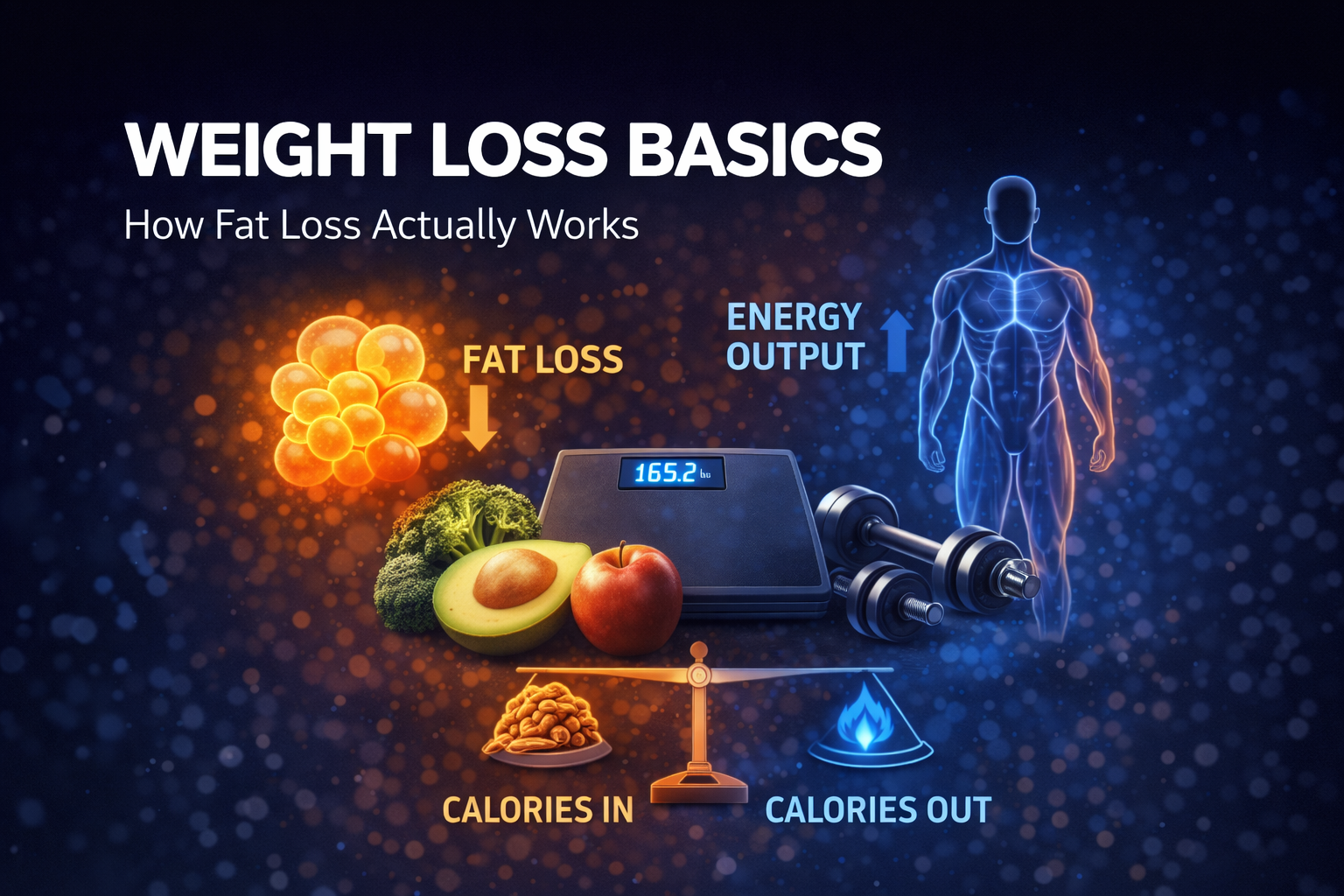
Fat loss is one of the most discussed topics in health and fitness, and one of the most distorted by marketing, fads, and oversimplified advice. Before you can make smart decisions about how to approach it, you need to understand the actual biology, not a slogan.
This article covers the fundamentals: what fat loss is, how it is driven, and why common framings around it often miss the point.
Energy Balance Is the Foundation
Fat loss, at its most fundamental level, is determined by energy balance: the relationship between calories consumed and calories expended. When the body takes in less energy than it uses over a sustained period, it draws on stored energy to meet the deficit. Stored body fat is one of those reserves.
This is not a controversial claim. It is a thermodynamic reality that no dietary approach, supplement, or hormone can override. The debates in nutrition, about carbs, insulin, meal timing, and food quality, are almost entirely debates about what most effectively influences one side of this equation for most people, not about whether the equation applies.
Where Fat Actually Goes When You Lose It
Most people, when asked, would say fat is converted to energy or excreted. The actual answer is more specific: when fat (triglycerides) is metabolized for energy, it is broken down into carbon dioxide and water. The majority of fat mass leaves the body through the lungs as exhaled CO₂. The remainder exits through sweat, urine, and other fluids.
This has no practical implication for how you approach fat loss, but it corrects a widespread misconception that fat is "burned" in muscle or somehow directly converted to heat.
What the Body Draws On During a Deficit
When calories are restricted, the body does not exclusively draw on fat tissue. It draws on available fuel sources: including glycogen (stored carbohydrate), body fat, and, in certain conditions, muscle protein. The proportion depends on several factors:
Protein intake: Higher protein intake spares muscle tissue during a deficit by providing amino acids and signaling a preserved anabolic environment.
Resistance training: Continuing to train with weights while in a deficit signals the body to maintain muscle mass, directing more of the deficit toward fat tissue.
Deficit size: Aggressive calorie restriction accelerates the rate of muscle loss relative to fat loss. Moderate deficits, generally 300–500 calories below maintenance, tend to produce better body composition outcomes over time.
"Eat less, move more" is technically accurate but practically incomplete. How you structure the deficit, protein intake, training, deficit size, food quality, determines how much of what you lose comes from fat versus muscle.
Total Daily Energy Expenditure
The "calories out" side of the equation is not a fixed number. Total daily energy expenditure (TDEE) is made up of several components:
Basal metabolic rate (BMR): The energy used to sustain basic physiological functions at rest. This is the largest component, typically 60–70% of total expenditure for sedentary individuals.
Thermic effect of food (TEF): The energy cost of digesting, absorbing, and processing food. Protein has the highest TEF of any macronutrient.
Non-exercise activity thermogenesis (NEAT): All movement that is not formal exercise: walking, fidgeting, standing, daily tasks. This is highly variable between individuals and highly adaptive. NEAT decreases meaningfully during prolonged calorie restriction, which is one reason fat loss slows over time.
Exercise activity thermogenesis (EAT): Formal exercise. Often overestimated as a driver of fat loss. An hour of moderate exercise burns a fraction of what most people assume.
Why Fat Loss Slows Over Time
Metabolic adaptation is real. As body weight decreases and calorie intake drops, the body makes adjustments that reduce TDEE: lowering BMR, reducing NEAT, and improving metabolic efficiency. This is a survival mechanism, not a malfunction. It is why the same calorie deficit that produced results in week two may produce little by week twelve.
Managing this requires periodically reassessing calorie targets as weight decreases, and using structured diet breaks or maintenance periods to partially restore metabolic rate.
Bottom Line
Fat loss requires a sustained calorie deficit. The quality of that fat loss, how much comes from fat versus muscle, how sustainable it is, and how well you feel during it, depends on how intelligently the deficit is structured. Protein intake, resistance training, and a moderate rather than aggressive deficit are the three variables that most determine whether fat loss is a positive experience or a damaging one.