One of the most common mistakes in fat loss is treating it as a state to be maintained permanently. People enter a calorie deficit and stay there indefinitely, cutting harder when results slow, tolerating increasing fatigue and hunger, and eventually crashing. The idea that you should be dieting until you reach your goal is both physiologically misguided and practically unsustainable.
Understanding how to structure different dietary phases, and when to use each, is what separates someone who loses fat and keeps it off from someone who cycles through the same 20 pounds repeatedly.
The Three Dietary Phases
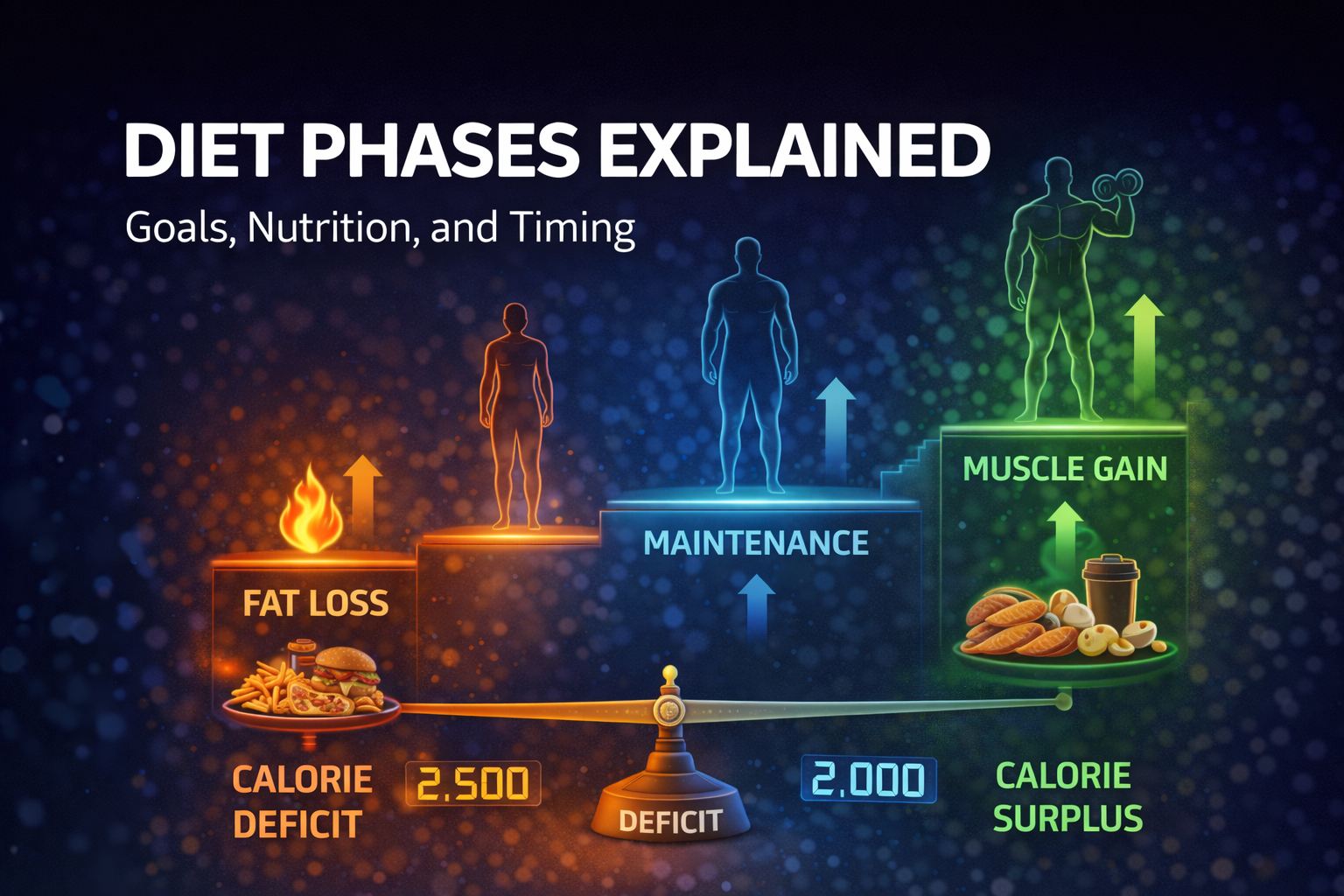
Calorie deficit: Eating below maintenance to drive fat loss. The primary phase for body composition improvement in individuals carrying excess fat or seeking to reduce body fat percentage.
Maintenance: Eating at approximately the level of total daily energy expenditure: neither gaining nor losing. Used strategically to reset metabolic adaptation, recover physiologically, and consolidate results.
Calorie surplus: Eating above maintenance to support muscle gain. Used in intentional building phases, particularly relevant for individuals with low muscle mass or those who want to improve strength and body composition simultaneously over a longer timeline.
Why Chronic Dieting Fails
Prolonged calorie restriction triggers a cascade of adaptive responses designed to preserve body weight. BMR decreases. Hunger hormones like ghrelin increase. Satiety hormones like leptin decrease. Non-exercise movement (NEAT) drops unconsciously. Thyroid output can be suppressed. The longer a deficit is sustained without a break, the more pronounced these adaptations become.
This is not a sign of failure; it is the body doing exactly what it is designed to do when energy availability is low. The practical implication is that a deficit that produced results in the first eight weeks will produce increasingly diminishing returns by week twenty, and that attempting to sustain that deficit indefinitely creates an adversarial relationship between willpower and biology that willpower will eventually lose.
A diet break is not a failure. Structured periods at maintenance are a tool for managing metabolic adaptation, restoring hormonal baselines, and extending the sustainability of a fat loss phase. They are part of an intelligent approach, not a departure from one.
How Long to Diet Before a Break
There is no universal answer, but as a general guideline, most people benefit from a structured maintenance period every 8–16 weeks of consistent deficit eating. The duration of the break depends on how aggressive the deficit was and how significant the adaptive response has become.
Signs that a break may be appropriate include: progress has stalled despite accurate tracking, persistent fatigue and low energy, significant strength loss, and heightened food preoccupation. These are not signs of weakness; they are physiological feedback worth taking seriously.
What Maintenance Phases Do
Eating at maintenance for a period of 1–4 weeks has been shown to partially reverse the metabolic adaptations associated with prolonged restriction. Leptin levels rise. Ghrelin decreases. NEAT naturally increases as energy availability improves. Muscle recovery and growth signaling improve.
Maintenance phases also provide psychological relief. The ability to eat normally for a period, without hypervigilance, restriction, or guilt, reinforces that a healthy relationship with food is possible and sustainable. This matters more than most training programs acknowledge.
When to Consider a Surplus Phase
For individuals who have been in a deficit for an extended period, or who have low muscle mass relative to their goals, a structured surplus phase (often called a "bulk") can be a strategic tool. Muscle tissue is built more efficiently in a slight calorie surplus, supported by progressive resistance training and high protein intake.
The expectation is not that a surplus will produce fat gain; a controlled surplus of 200–300 calories above maintenance, with consistent training, produces mostly muscle gain with minimal fat accumulation. The key word is controlled.
Bottom Line
Fat loss is not a single continuous phase. It is a series of structured periods, deficit, maintenance, and sometimes surplus, managed strategically over time. The goal is not to diet as hard as possible for as long as possible. The goal is to lose fat, preserve muscle, maintain health, and build a relationship with food and your body that can last far beyond any single phase.