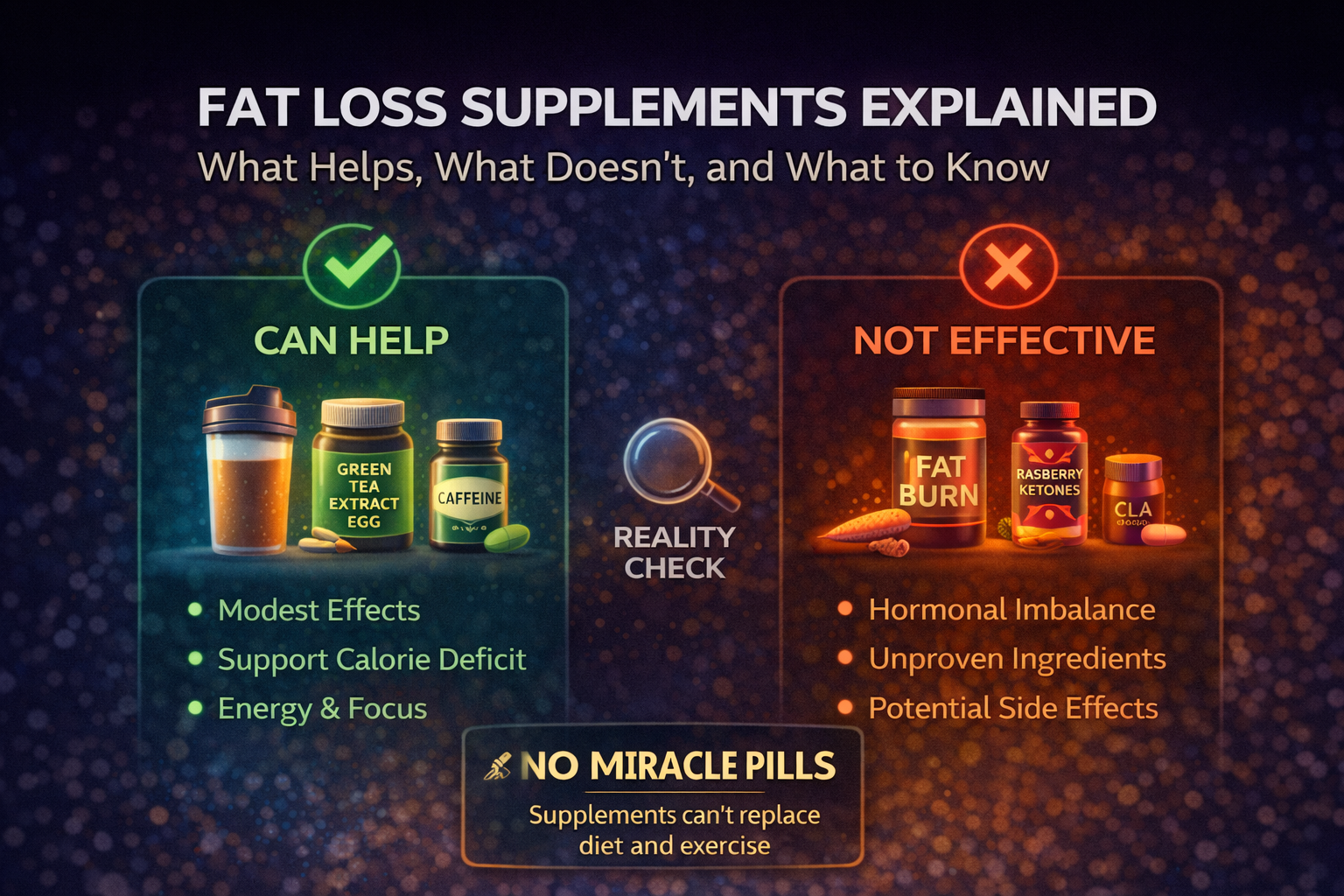
The fat loss supplement industry generates billions of dollars annually, built almost entirely on the gap between what people want to believe and what the evidence actually supports. The marketing is aggressive, the labels are impressive, and the reality is largely disappointing. This article is an honest assessment of what the research shows, not what supplement companies want you to hear.
The Framework for Evaluating Any Supplement
Before reviewing specific compounds, it helps to have a framework. For a fat loss supplement to be worth considering, three things need to be true: there is meaningful, peer-reviewed evidence of efficacy; the effect size is large enough to matter in practice; and the risk profile is acceptable. Most supplements fail at step one. Some that pass step one fail step two.
Caffeine: The One That Actually Works
Caffeine is by far the most evidence-supported fat loss aid available. It increases fat oxidation, raises basal metabolic rate modestly, suppresses appetite temporarily, and improves performance during training, which indirectly contributes to greater calorie expenditure. Its effects are well-documented in dozens of controlled trials.
The practical limitation is tolerance. Regular caffeine users develop tolerance quickly, and the thermogenic effect diminishes with daily use. Cycling caffeine, using it strategically rather than continuously, preserves its utility. People who are caffeine-sensitive, pregnant, or managing cardiovascular conditions should approach it with appropriate caution.
Protein Supplements: Indirectly Useful
Protein supplements, whey, casein, plant-based blends, do not have direct fat-burning properties. Their value for fat loss is indirect: they make it easier to hit daily protein targets, which supports muscle preservation during a deficit and improves satiety. These are meaningful contributions. If whole food sources cover your protein needs, supplemental protein adds little. If they don't, a quality protein supplement is a practical tool.
No supplement creates a fat loss effect large enough to compensate for a diet that is not aligned. The ceiling of supplement contribution to fat loss is small. The floor of dietary structure required is not.
Green Tea Extract: Modest at Best
Green tea extract (GTE) contains both caffeine and catechins, particularly EGCG, that in combination show modest thermogenic effects in research. The effect size is small: studies suggest an additional 80–100 calories per day of energy expenditure at best. This is not nothing, but it is not a meaningful driver of fat loss on its own. It may have value as part of a stacked pre-workout or as a mild metabolic support tool in a structured diet, not as a standalone solution.
Thermogenics and "Fat Burners": Mostly Marketing
Products marketed as fat burners or thermogenics typically combine caffeine with several other compounds: synephrine, yohimbine, L-carnitine, CLA, raspberry ketones, in a proprietary blend. A few of these have marginal evidence behind them individually. Most do not. The combined product is rarely studied as a whole, doses in proprietary blends are often underdisclosed, and effect sizes are consistently small to negligible.
Some thermogenic products carry real risks: cardiovascular strain, anxiety, sleep disruption, and in some cases, adverse interactions with medications. The risk-to-reward ratio for most of these products is poor.
What to Skip Entirely
Raspberry ketones, garcinia cambogia, conjugated linoleic acid (CLA), and most "detox" or "cleanse" products have either no meaningful human evidence of efficacy or effect sizes too small to justify the cost. These categories are almost entirely marketing-driven. Spending money on them comes at the cost of spending it on things that actually matter: food quality, training, and recovery.
Bottom Line
If you are looking for a supplement edge on fat loss, caffeine is the only widely available compound with consistent, meaningful evidence. Protein supplementation helps if your diet needs it. Everything else is either marginal or noise. The most effective fat loss intervention available is a well-structured diet, consistent training, adequate sleep, and managed stress, and none of those come in a capsule.