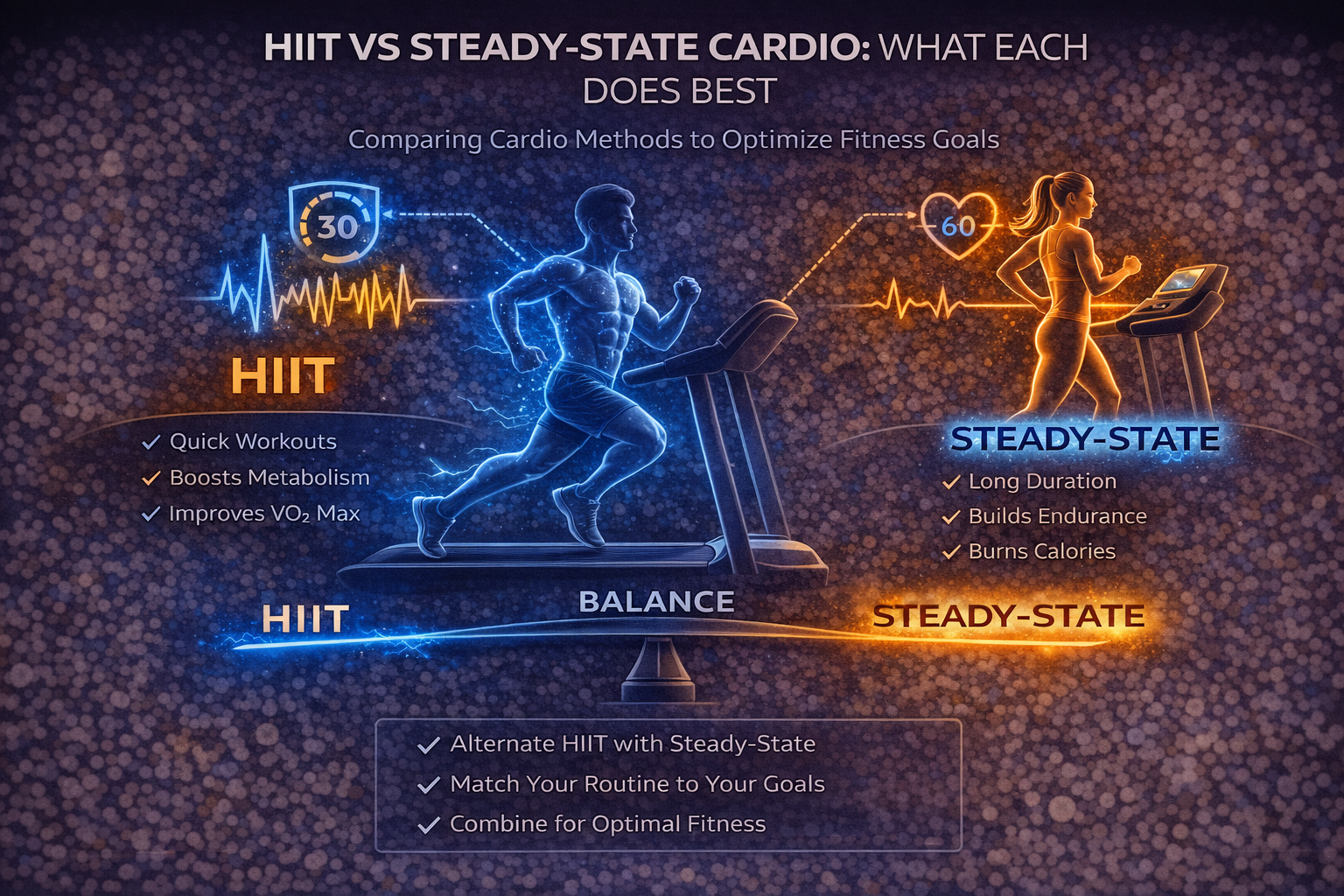
The HIIT versus steady-state debate has been a fixture in fitness circles for years. It is often framed as a competition: which one is better for fat loss, which one is better for your heart, which one should you choose. The framing itself is the problem. These are not competing options. They are different tools with different mechanisms and different ideal applications. Understanding this distinction makes programming far more intelligent.
Defining HIIT
High-intensity interval training alternates periods of near-maximal effort with recovery periods. True HIIT requires effort at 85–95% of maximum heart rate during work intervals. Sessions are short, typically 20–30 minutes including warm-up and cool-down, because the intensity makes sustained effort impossible beyond that.
HIIT is not a moderate-effort workout performed in intervals. Intervals performed at 65% effort are not HIIT; they are moderate-intensity interval training. The defining characteristic is effort level, not format.
Defining Steady-State Cardio (LISS)
Low-intensity steady-state cardio (LISS) is sustained aerobic activity at a consistent moderate effort, typically 55–70% of maximum heart rate, for 30–60 minutes or more. Walking, cycling at a comfortable pace, swimming, elliptical at low resistance. The defining characteristic is that the effort is sustainable for an extended duration without significant fatigue accumulation.
What HIIT Does Well
Cardiovascular adaptation: HIIT produces strong improvements in VO2 max, maximal aerobic capacity, in a relatively short training time. Studies consistently show that shorter HIIT protocols can produce comparable cardiovascular improvements to longer steady-state sessions.
Time efficiency: For individuals with limited time who want to maximize cardiovascular benefit per minute, HIIT delivers. A 20-minute HIIT session produces meaningful cardiovascular stimulus.
EPOC: HIIT produces a larger post-exercise oxygen consumption response than steady-state: meaning calorie burn continues at an elevated rate for hours after the session. The practical size of this effect is often overstated, but it is real.
Metabolic conditioning: Repeated high-intensity intervals improve the body's ability to rapidly produce and manage energy across multiple metabolic pathways simultaneously.
HIIT is demanding. It requires recovery. Adding multiple HIIT sessions to a week already containing hard resistance training sessions will often do more harm than good, not because HIIT is bad, but because the total stress exceeds the recovery capacity of most people.
What Steady-State Cardio Does Well
Aerobic base development: Sustained moderate-intensity training builds the aerobic foundation, improving mitochondrial density, fat oxidation capacity, and cardiac efficiency, that underpins all exercise performance. Aerobic base training is where elite endurance athletes spend 70–80% of their training volume.
Low recovery cost: LISS can be performed on recovery days without meaningfully adding to accumulated fatigue from resistance training. A 45-minute walk after a hard lifting session is often actively beneficial.
Calorie expenditure without stress: For individuals managing calorie balance, LISS provides additional expenditure without adding to the training stress that impairs recovery and adaptation.
Mental health and adherence: Many people genuinely enjoy lower-intensity activity: walking, hiking, cycling at an easy pace. Sustainable long-term activity is worth more than optimally intense activity that is difficult to maintain.
How to Combine Them
For most people who resistance train 3–4 days per week, a reasonable cardio structure might look like: 1–2 LISS sessions per week on off days, and optionally 1 HIIT session per week if recovery capacity allows. This provides cardiovascular benefit, additional calorie expenditure, and active recovery, without overwhelming the system.
As total training volume or life stress increases, LISS holds better than HIIT. HIIT adds to cumulative fatigue in ways that are difficult to manage without deliberate programming.
Bottom Line
HIIT is not universally superior to steady-state cardio, and steady-state cardio is not outdated. They produce different adaptations through different mechanisms and carry different recovery costs. The best cardio protocol is the one that fits your recovery capacity, training schedule, and preferences, and that you will actually do consistently over time.