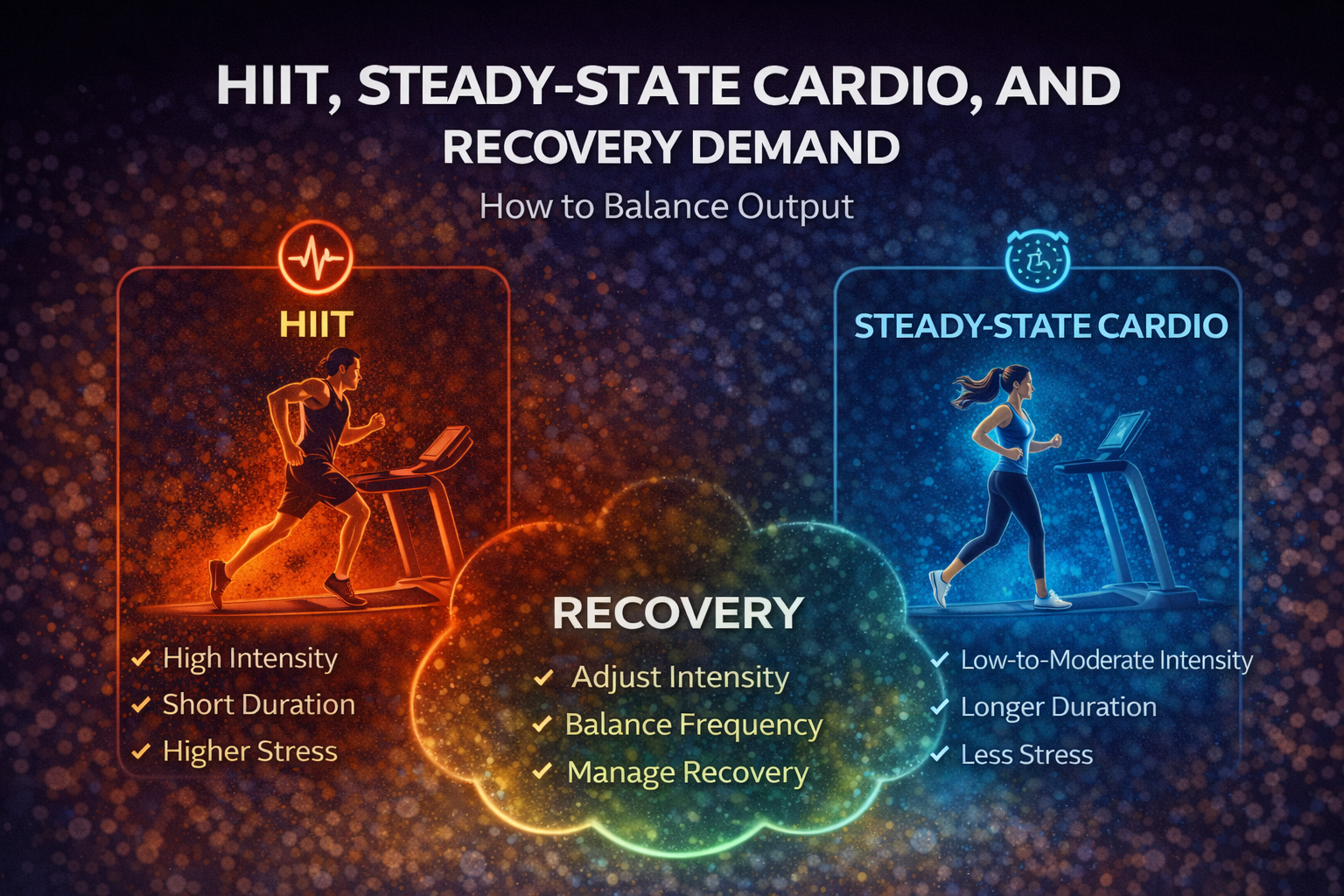
Not all cardio is created equal, and not just in terms of calorie burn or cardiovascular benefit. Different modes of cardiovascular exercise carry significantly different recovery costs. Understanding this distinction is essential for anyone combining cardio with resistance training, managing a busy schedule, or trying to improve performance without accumulating fatigue faster than the body can manage it.
What HIIT Actually Is
High-intensity interval training (HIIT) involves alternating periods of near-maximal effort with periods of rest or low-intensity recovery. True HIIT is demanding; it requires effort at 85–95% of maximum heart rate during work intervals. The physiological adaptations it produces include improved VO2 max, enhanced mitochondrial density, better lactate threshold, and increased calorie expenditure both during and after the session (through excess post-exercise oxygen consumption, or EPOC).
The recovery cost of HIIT is high. It draws significantly on the same neuromuscular and systemic recovery resources as heavy resistance training. For someone training 4–5 days per week with weights, adding multiple HIIT sessions is often a fast path to accumulated fatigue and declining performance.
What Steady-State Cardio (LISS) Is
Low-intensity steady-state cardio (LISS) is performed at a consistent, moderate effort, typically 55–70% of maximum heart rate, for an extended duration. Walking, easy cycling, incline treadmill, swimming at a conversational pace. The intensity is low enough that the effort feels sustainable, breathing is manageable, and conversation is possible.
LISS has a much lower recovery cost than HIIT. It can be performed on rest days as active recovery, it improves aerobic base and fat oxidation capacity, and it supports cardiovascular health without significantly adding to systemic fatigue. For most people combining cardio with resistance training, LISS is far more sustainable at higher frequencies.
HIIT is not superior to LISS; it is different. HIIT is time-efficient and produces strong cardiovascular adaptations. LISS is low-impact, sustainable, and adds to calorie expenditure without meaningfully impairing recovery from training. Both have a place in a well-structured program.
The Recovery Cost Comparison
To understand why this matters, consider a person resistance training four days per week and adding two HIIT sessions. That is six days of training with a significant recovery demand. If sleep and nutrition are not optimal, which they often aren't, this volume frequently exceeds the body's recovery capacity.
In contrast, that same person adding two 30–45 minute LISS sessions on off days creates a meaningfully different load. The cardiovascular benefit is real, calorie expenditure increases, and the recovery system is not significantly further stressed.
When to Use Each
HIIT is well-suited for: individuals with limited time who need to maximize cardiovascular adaptation per minute; trained athletes with high recovery capacity; and those in periods when resistance training volume is lower and recovery headroom is available.
LISS is well-suited for: active recovery days between resistance training sessions; anyone in a significant calorie deficit where recovery resources are reduced; beginners building aerobic base before adding intensity; and general health maintenance.
Both can coexist in a well-structured week, for example, one HIIT session paired with two LISS sessions, while four resistance training sessions form the primary workload. The key is ensuring total training volume does not exceed recovery capacity on a consistent basis.
Signs Your Cardio Volume Is Too High
Declining performance in resistance training over multiple weeks; persistent fatigue that is not resolved by a rest day; increased resting heart rate over a sustained period; sleep disruption; and loss of motivation to train are all indicators that total output may be exceeding recovery capacity. The response should be a reduction in volume, not pushing harder.
Bottom Line
Cardio is a tool, and like all tools, it works best when matched to the job. HIIT produces strong adaptations with a high recovery cost. LISS supports cardiovascular health and calorie expenditure with minimal recovery overhead. Most people training consistently benefit from having more LISS and less HIIT than they initially assume, and would see better overall results by managing total output against recovery capacity rather than simply doing more.